
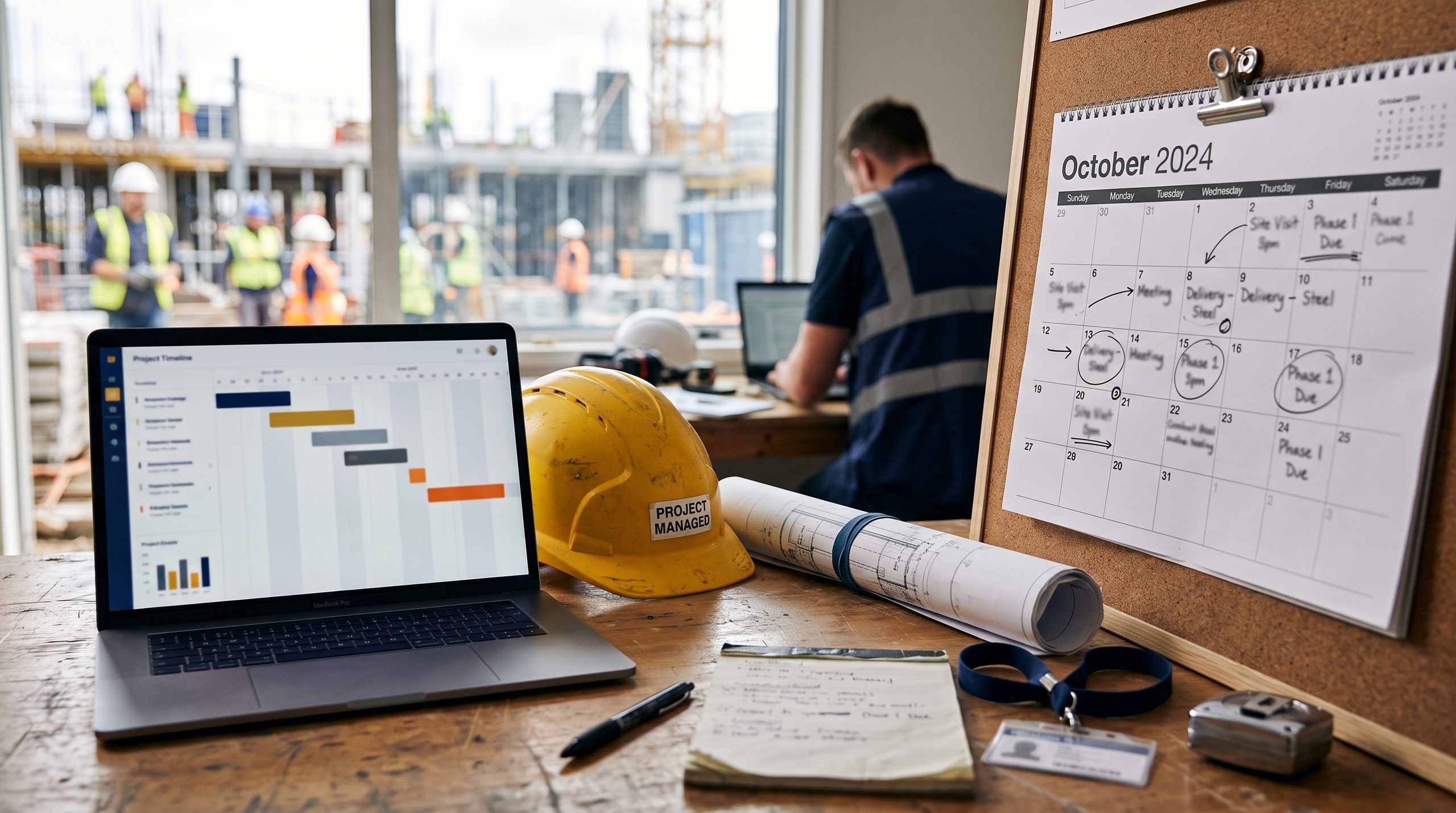
Scan through almost any construction software’s marketing page and a Gantt chart is front and center — colorful bars, dependency lines, a timeline stretching across the screen. It looks impressive, and for certain kinds of projects, it genuinely earns its place. But for a lot of small contractors, a simple calendar view gets the job done just as well, minus the added complexity.
Understanding the real difference between the two helps you avoid paying for — and wrestling with — a feature you may not actually need.
A quick note: the right choice depends heavily on the type and complexity of the jobs you run. Neither option is universally “better.”
What a Gantt Chart Actually Shows
A Gantt chart is a horizontal bar chart that maps tasks over time, with each bar showing a task’s start date, duration, and end date. Its real strength is dependency tracking — showing which tasks can’t start until another one wraps up, like framing needing to finish before electrical work can begin.
For projects with multiple phases that depend on each other, a Gantt chart makes it much easier to see the ripple effect of a delay. If framing runs a week behind, a Gantt chart visually shows exactly which downstream tasks get pushed back as a result.
What a Simple Calendar View Shows
A calendar view, on the other hand, just shows what’s happening on which day, laid out the way most people already think about scheduling in everyday life. There’s no dependency mapping, no visual breakdown of task duration beyond the days it spans. It answers a much simpler question: what’s happening today, tomorrow, this week.
For jobs without complicated phase dependencies, a calendar view tends to be faster to scan at a glance, especially for crew members checking their schedule quickly from a phone out in the field.
When a Gantt Chart Genuinely Helps
Gantt charts tend to earn their complexity on larger, multi-phase projects where several trades or steps depend on each other in sequence. A remodel involving demolition, framing, electrical, plumbing, drywall, and finishing work benefits from a Gantt chart because delays in one phase have a clear, trackable knock-on effect on everything after it.
They’re also handy when coordinating multiple subcontractors on the same project, since a Gantt chart makes it easier to see where different trades’ timelines overlap or depend on each other.
When a Simple Calendar Is Genuinely Enough
For a lot of small contractors — especially those running shorter jobs, single-trade work, or several independent projects at once rather than one big multi-phase build — a Gantt chart adds visual complexity without adding much practical value. A calendar view answering “where’s everyone today and tomorrow” is often exactly what’s needed, and nothing more.
Solo contractors and small crews juggling a handful of relatively simple, independent jobs at a time frequently find that a calendar view is quicker to update and easier for the whole team to actually stick with.
The Real Cost of Choosing the Wrong One
Choosing a Gantt-chart-heavy platform when a calendar would do fine often means paying for a pricier, more complex tool the crew ends up avoiding because it takes too long to update. On the flip side, relying on a simple calendar for a genuinely complex, multi-phase project can mean losing visibility into how a delay in one area cascades through the rest of the schedule — which can lead to missed deadlines that don’t become obvious until it’s too late.
The mismatch tends to show up one of two ways: either the software feels like overkill and the crew stops updating it consistently, or the software feels too basic and real scheduling conflicts slip through unnoticed.
A Practical Way to Decide
A useful test: think back to a recent project and ask whether a delay in one task created a clear, trackable ripple through several other tasks. If the answer’s regularly yes, a Gantt chart is probably worth the added complexity. If most jobs are fairly self-contained, with few dependencies between tasks or trades, a simple calendar view is probably enough — and will likely get used more consistently by the whole team.
Plenty of construction scheduling platforms actually offer both views inside the same tool, letting a business default to a simple calendar day to day while switching over to a Gantt view specifically for larger, multi-phase projects when it’s needed.
Frequently Asked Questions
Can a business use both a calendar and a Gantt chart at the same time? Yes. Many scheduling platforms build both views into the same schedule, letting a business use whichever fits a given project without needing separate tools.
Is a Gantt chart harder for a crew to learn than a calendar? Generally yes, at least at first. Calendar views tend to map more directly onto how people already think about scheduling, while Gantt charts take a bit more familiarity to read confidently.
Do larger contractors always need Gantt charts? Not automatically. It comes down more to how many interdependent phases or trades a typical project involves than to the size of the business itself.
In Summary
Gantt charts and simple calendars aren’t a case of one being objectively better than the other — they’re built for different levels of project complexity. Gantt charts earn their place on multi-phase projects with real task dependencies, while a simple calendar view is often the more practical, more consistently used choice for smaller, more self-contained jobs. Matching the tool to the actual complexity of your typical project, rather than defaulting to whichever one looks more advanced, leads to a scheduling system your team will actually keep up with.